
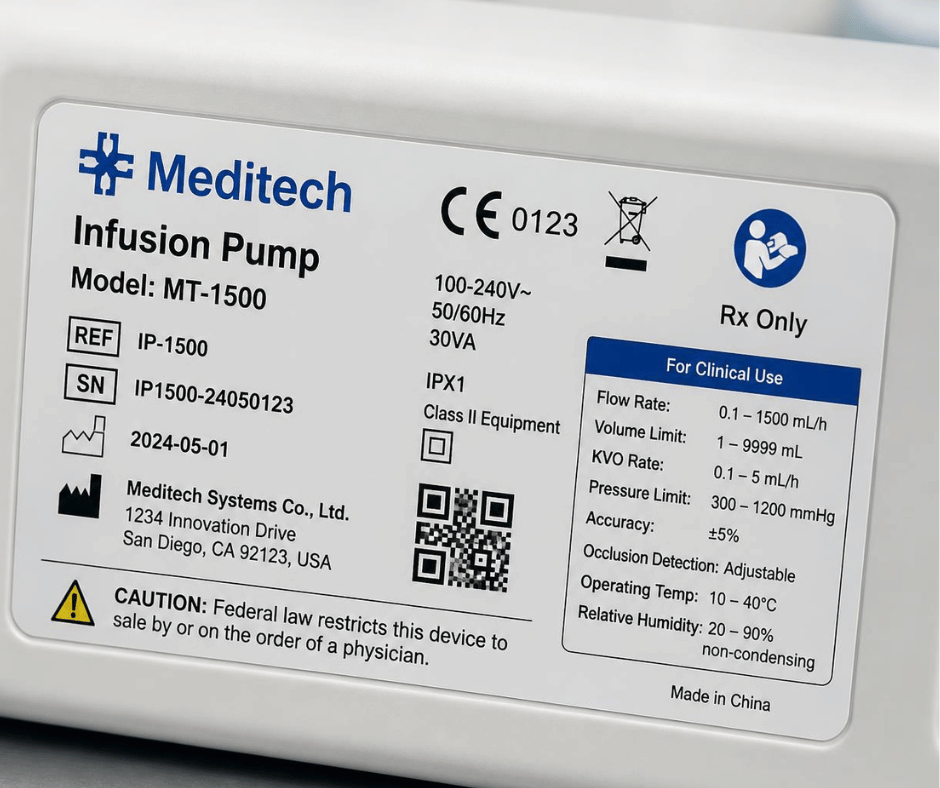
When preparing a medical device sanitary registration dossier in Mexico, one of the mandatory documents requested by COFEPRIS is the label design.
Although the term is widely used within the Mexican regulatory environment, it is often misunderstood. Many assume that a label design is simply a draft version of the final commercial label that will be printed and placed on the product. In reality, its regulatory purpose is very different.
Understanding the role of the label design is essential not only for obtaining a sanitary registration, but also for ensuring that the information provided to COFEPRIS accurately reflects the labeling that will accompany the device once commercialized in Mexico.
What Is a Label Design?
A label design is a regulatory document submitted as part of a sanitary registration application that compiles all labeling information required for a medical device in Mexico.
Under the Mexican regulatory framework, labeling compliance is assessed against the requirements established in NOM-137-SSA1-2025, which defines the information that must be made available to users and healthcare professionals throughout the labeling system.
In practical terms, the label design is usually generated from two primary sources:
- The manufacturer’s original label.
- The additional information required by NOM-137-SSA1.
The resulting document becomes a comprehensive regulatory reference that demonstrates how the device labeling will comply with Mexican requirements.
The Label Design as a Regulatory Guide
One of the most important concepts to understand is that the label design represents the complete labeling framework expected for the Mexican market.
The original manufacturer label is only one component of that framework. In many cases, the original labeling does not contain all information required by Mexican regulations. As a result, additional information must be incorporated through a counter-label, over-label, back-label, or secondary label, as permitted by Mexican regulations. This concept has been previously discussed in our article about medical device labeling requirements in Mexico.
For this reason, the label design serves as a practical tool to:
- Identify missing regulatory information.
- Determine whether a counter-label will be required.
- Verify consistency among labeling, technical documentation, and the sanitary registration application.
- Establish the content that must ultimately be available to the user.
In other words, the label design functions as a roadmap for achieving labeling compliance rather than as a commercial artwork.
Why Is the Label Design Important for COFEPRIS?
Beyond being a submission requirement, the label design plays an important role during the regulatory review process.
COFEPRIS evaluates not only the technical characteristics of a medical device but also whether users will receive the information necessary for its safe and effective use. According to NOM-137-SSA1-2025, labeling is part of the overall safety and performance strategy of a medical device and must include information such as intended use, warnings, precautions, traceability elements, and other safety-related content when applicable.
The label design therefore acts as a formal notification to COFEPRIS regarding the information that will accompany the product once it reaches the Mexican market. The authority relies on this information when assessing whether the device can be used safely under the proposed conditions of use.
For this reason, omissions or inconsistencies in the label design frequently generate questions during the review process and may affect approval timelines.
What a Label Design Is Not
A common misconception is that the label design must look exactly like the final label that will be printed on the product packaging.
This is not its purpose.
A label design is not intended to be a production-ready artwork. In many cases, it contains information that would not be practical to display in a final packaging layout, such as lists of multiple product codes included in a registration, alternative presentations etcetera.
Similarly, the label design should not be interpreted as a requirement to completely redesign the manufacturer’s original label.
Mexican regulations recognize the value of the original labeling and allow manufacturers to supplement missing information through compliant secondary labeling when necessary.
Therefore, the objective is generally not to replace the original label but to demonstrate how the complete set of required information will be made available to the end user.
Relationship Between the Original Label, the Counter-Label, and the Label Design
A useful way to visualize these concepts is as follows:
- Original label: Information already provided by the manufacturer.
- Counter-label: Information added to satisfy Mexican regulatory requirements when the original label is incomplete.
- Label design: The complete regulatory picture showing all information that must be available for compliance.
The label design consolidates both sources of information and allows regulators and registration holders to identify any potential gaps before commercialization.
As a result, it becomes one of the most valuable tools for preventing labeling deficiencies and ensuring alignment between the sanitary registration, labeling documentation, and the final marketed device.
Frequently Asked Questions (FAQ): Label Design in Mexico
- Do I need to redesign my global label specifically for Mexico?
Not necessarily. Mexican regulations generally consider the manufacturer’s original label as part of the overall labeling system. If certain required information is missing, it can often be added through a compliant counter-label rather than completely redesigning the global artwork.
- Why does COFEPRIS require a label design during the registration process?
The label design allows COFEPRIS to evaluate whether the information that will accompany the medical device is sufficient for its safe and effective use. It serves as a formal representation of the labeling content that will be available in the Mexican market and helps the authority assess compliance with applicable labeling requirements before granting the sanitary registration.
- Is a label design the same as the final label that will be printed on the product?
No. A label design is a regulatory document prepared for the sanitary registration process, not a production-ready artwork. Its purpose is to demonstrate compliance with Mexican labeling requirements and to show COFEPRIS all labeling information that will be available to the user.
Conclusions
The term label design should not be confused with a commercial packaging draft or final artwork. In Mexico, the label design is a mandatory regulatory document used during sanitary registration applications to demonstrate compliance with labeling requirements established by NOM-137-SSA1. It is built from the manufacturer’s original labeling together with any additional information required by Mexican regulations.
Most importantly, the label design serves as a regulatory guide for manufacturers, registration holders, and COFEPRIS reviewers. It helps identify missing information, supports the development of compliant counter-labels when necessary, and communicates to the authority the labeling information that will be provided to users once the device is commercialized in Mexico.
Rely on Veraque as your partner for navigating medical device labeling and sanitary registration in Mexico. With more than 15 years of experience supporting international manufacturers, we deliver expert guidance to ensure compliance and efficiency.